
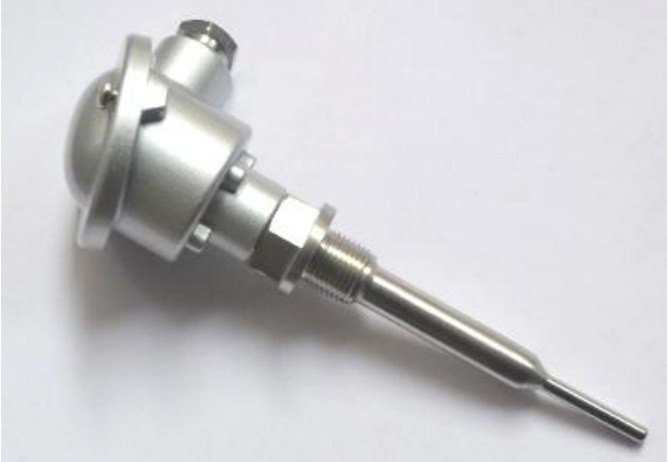
Selecting a temperature sensor by range, accuracy and mounting.
Ovens, extruders and pasteurisers cannot work properly without temperature control. Industry relies on two main sensor families: thermocouples and RTDs (PT100/PT1000).
How a thermocouple works
A thermocouple is a closed circuit of two dissimilar conductors: a temperature difference between the ends produces a thermoelectric EMF (Seebeck effect). Thermocouples cover wide ranges and high temperatures.
Thermocouple types
| Type | Range | Short-term | Use |
|---|---|---|---|
| K | −200…1000°C | 1200°C | Most widely used |
| J | 0…600°C | 750°C | Medium temperatures |
| T | −200…300°C | 350°C | Low temperature, precision |
| E | −200…700°C | 800°C | Highest thermo-EMF |
| N | −200…1200°C | 1250°C | Stable thermo-EMF |
| R / S | 0…1400°C | 1600°C | High accuracy, reference |
| B | 0…1500°C | 1700°C | Highest temperatures |
Full table: thermocouple types and selection guide.
When PT100 is better
An RTD relies on the change of a conductor's resistance with temperature. PT100 is more stable and accurate at medium temperatures; the head-mounted WZP sensor measures liquids, steam and gases from −200 to +420°C. Cable versions: Teflon-cable PT100, silicone and fibreglass.
Selection steps
- Check which input your instrument (controller) accepts.
- Define the process temperature and medium (air, liquid, aggressive media).
- Choose mounting: thread, flange, spring clamp or probe.
- Sheathed thermocouples can be bent — minimum radius 3–5× the sheath diameter, not within 10 diameters of the tip.
High-temperature ovens and extruders usually use type K; precise medium temperatures call for PT100. Send probe dimensions, cable length and connection type — we will select a suitable sensor. Specifications are for information only and are confirmed for each specific order.