
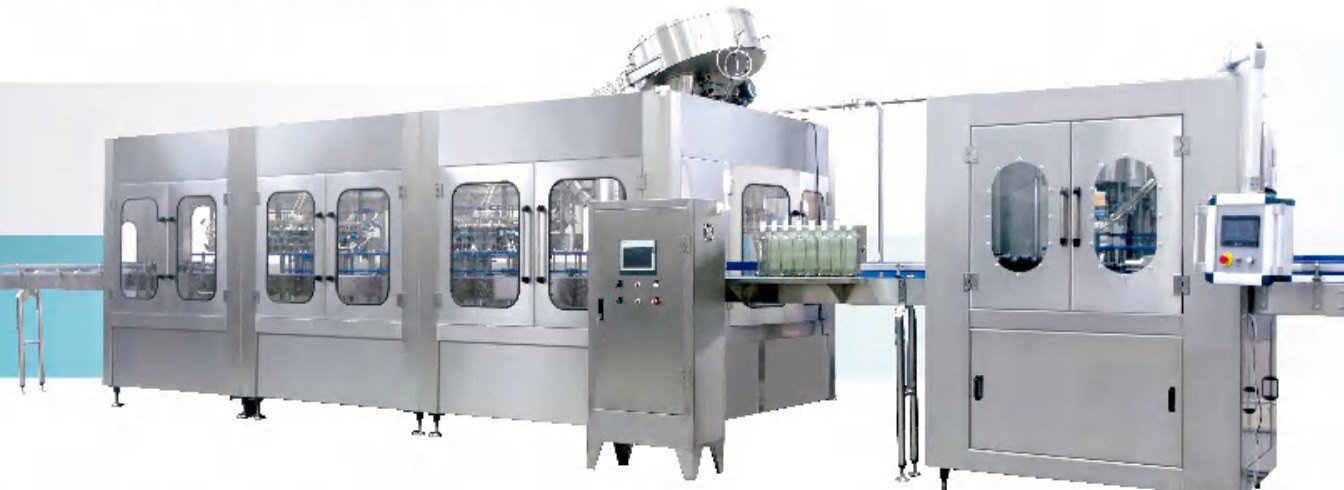
Filling machines, capping and labelling for glass bottles and cans, compared with a model table.
A plant starting wine, vodka, beer or soft-drink production first chooses the container: glass bottle or metal can? The filler, capper and labeller all depend on that choice. Below we compare both options using the equipment in the Afitin Group catalogue.
Glass bottle or can?
| Criterion | Glass bottle | Metal can |
|---|---|---|
| Typical product | Wine, vodka, brandy, beer, soft drinks | Beer, cola, carbonated drinks, sparkling fruit wine |
| Filling machine | CGF(B) series (rinsing, filling, capping) | Linear or rotary can filler |
| Closure | Crown cap, aluminium ROPP cap or screw cap | The lid is seamed on the machine |
| Label | Paper or self-adhesive label | Cans usually arrive pre-printed |
CGF(B) filler for glass bottles
The CGF(B) series combines rinsing, filling and capping in one frame. According to the catalogue it handles sparkling water, carbonated drinks, soda, yoghurt and juice drinks, sparkling and still wine, vodka and beer. It works with bottles of Ø49–90 mm diameter and 160–290 mm height.
| Model | Capacity (0.5 L, bottles/h) | Rated power (kW) |
|---|---|---|
| CGF14-12-5(B) | 2000–3000 | 4.5 |
| CGF16-16-5(B) | 4000–5000 | 4.8 |
| CGF24-24-8(B) | 6000–8000 | 5.5 |
| CGF32-32-10(B) | 8000–10000 | 7.5 |
| CGF40-40-10(B) | 10000–12000 | 8.5 |
| CGF50-50-12(B) | 14000–16000 | 10 |
| DCGF60-60-15(B) | 18000–20000 | 12 |
| DCGF72-72-18(B) | 22000–24000 | 15 |
The filling valves follow a "no bottle, no fill" rule, the tank level is PLC-controlled and speed is set by a frequency converter. The machine needs compressed air at 0.2–0.8 MPa.
How to size it: divide the daily plan by shift hours and add a 15–20% margin. For example, 40,000 bottles (0.5 L) in an 8-hour shift is about 5,000 bottles/h. With a margin, that points to the CGF24-24-8(B) class (6,000–8,000 bottles/h).
Filling and seaming cans
Beer and carbonated drinks are filled into cans isobarically: the can is first pressurised to the tank pressure, then the drink flows in without foaming or losing CO₂. The catalogue offers two options:
- Linear can filler: for aluminium, PET and tin cans. The catalogue recommends it for small and medium plants; remote control can be added.
- Rotary 2-in-1 can filler: filling and seaming in one machine. Valves are lowered pneumatically without touching the can. For medium and large output; a steam ejector for tank vacuum can be added.
Can filler capacity depends on can volume and number of heads and is confirmed in the technical and commercial offer.
The closure depends on the product
The catalogue lists six types of capping machines. A glass-bottle drinks line usually needs:
- Crown caps: beer and carbonated drinks in glass.
- Aluminium ROPP caps: the cap is roll-formed onto the neck. For vodka, brandy and other spirits.
- Plastic screw caps: soft drinks and still drinks.
Corking wine bottles requires separate equipment, confirmed on order.
Labelling and packing
Paper labels on glass call for a cold-glue labeller; the self-adhesive labels common on wine and vodka bottles need a self-adhesive labeller. Finished goods are packed in shrink film or cartons and stacked by a palletiser.
A typical line sequence
- Preparation: mixing tanks and, for carbonated drinks, a QHS carbonator.
- Empty bottles or cans fed by a depalletiser.
- Rinsing, filling and closing: CGF(B) or a can filler.
- Where needed, warming or cooling bottles in a tunnel.
- Labelling and date coding.
- Group packing and palletising.
All fillers are in the filling machines section. For water, see our separate guide: how to choose a water filling line.
What to send with your request
- Product: wine, vodka, beer, soft drink; carbonated or still.
- Container: glass bottle or can, volume, neck and closure type (sample or drawing).
- Required capacity (bottles/h).
- Plant dimensions, power supply and compressed air.
Send these details through the request form and Afitin Group will select the machines and prepare a technical and commercial offer.
Frequently asked questions
Can one machine fill both wine and vodka?
According to the catalogue, the CGF(B) series handles sparkling and still wine, vodka and beer. A different bottle size needs change parts, which are specified in the order.
Which bottles does the CGF(B) handle?
Glass bottles of Ø49–90 mm diameter and 160–290 mm height. Capacity for 0.5 L bottles ranges from 2,000–3,000 to 22,000–24,000 bottles/h depending on the model.
Why is isobaric filling needed?
To keep the CO₂ in beer and carbonated drinks. The container is pressurised to tank pressure so the drink flows in without foaming. Both can fillers in the catalogue are isobaric.
What closure is used for vodka bottles?
Usually an aluminium ROPP cap roll-formed onto the neck. Beer uses crown caps and soft drinks use plastic screw caps.
Specifications are for information only and are confirmed for each specific order.