
Which heaters suit the manifold, nozzle and barrel, and whether to use a J or K thermocouple: catalogue tables and installation rules.
In a hot runner mould the plastic stays molten in the manifold and nozzles. That removes the sprue and shortens the cycle, but only if the temperature stays stable. A nozzle that runs cold freezes off; one that runs hot causes stringing, burn marks and discolouration. Heaters and thermocouples hold the temperature together. This article explains which element each zone needs and how to choose it.
Where does a mould need heat?
| Zone | Heater | Catalogue figures |
|---|---|---|
| Injection machine barrel | Mica band heater | Surface ≤450°C (with PID), 3 W/cm² (max 3.5) |
| Hot runner manifold | Flexible tubular heater | 700°C, 230 V, straight length up to 3000 mm |
| Nozzle | Coil heater, B/C series | 700°C, 230 V, 125–1200 W depending on series |
| Temperature control | Type J or K thermocouple | J: 0…600°C, K: −200…1000°C |
Mould plates themselves usually use cartridge heaters. We cover them separately: how to choose a cartridge heater.
Flexible tubular heater for the manifold
The flexible double-ended heater is laid into the manifold channels and bent on site to follow them. The sheath is brass or stainless steel, with a round, square or rectangular section. Both versions reach 700°C surface temperature at 230 V, with a maximum straight length of 3000 mm.
| Parameter | Brass sheath | Stainless steel sheath |
|---|---|---|
| Dielectric strength (cold) | 800 V | 1500 V |
| Min. inner bend radius | R8 mm | R9 mm |
| Insulation resistance | ≥1.5 MΩ | ≥1.5 MΩ |
| Leakage current | ≤0.5 mA | ≤0.5 mA |
| Power tolerance (cold) | +5% / −10% | +5% / −10% |
| Length / diameter tolerance | ±3 mm / ±0.15 mm | ±3 mm / ±0.15 mm |
When bending, keep two rules: each end has 30 ±5 mm of unheated length and 35 ±2 mm of cold length that must not be bent, and the inner bend radius must not go below the minimum (R8 / R9 mm). Surface load depends on the section. For example, with a stainless sheath a round Ø5 mm section gives 10 W/cm², Ø8.5 mm gives 7.5 W/cm² and an 8×8 mm square gives 6.5 W/cm² (230 V).
Coil heater for the nozzle
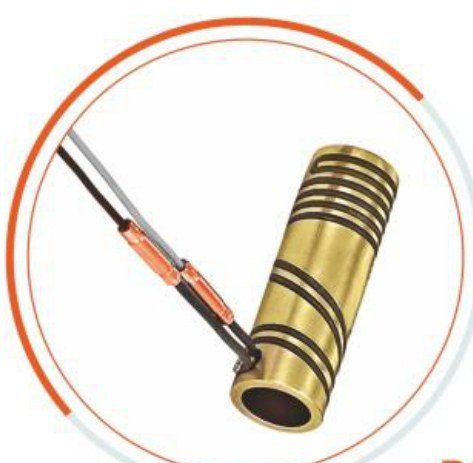
The coil heater slides over the nozzle. It comes in flat, round and square sections, with a built-in J or K thermocouple (B2 / B3) or without one. Surface temperature is 700°C, voltage 230 V, dielectric strength 600 V. Size and power are made to drawing.
| Series | Size range | Power (230 V) |
|---|---|---|
| B | Inner Ø16–50 mm, height 15–100 mm | 150–950 W |
| B (small) | Inner Ø12–22 mm, height 25–200 mm | 200–550 W |
| C1 / C2 | Developed length 235–1535 mm (heated 200–1500 mm) | 150–1200 W |
| C3 / C4 | Ø19–22 mm, height 30.5 mm | 250 W |
| Double-ended disc coil | Developed length 390–1870 mm | 125–800 W |
Power tolerance is ±10% up to 200 W and +5% / −10% above 200 W. The lead exit is chosen for the conditions: stainless braid (SBL-1), composite soft sleeve (SBL-2), black rubber-fibre sleeve (SBL-3/4) or nickel-plated copper wire (SBL-5).
An alternative is the stainless steel coil heater ring: 115–2000 W, inner diameter 10–42 mm, with a K, J or E control thermocouple. These rings are used in hot runner moulds, blow moulders and extruders.
Thermocouple: J or K?
Hot runner systems mostly use type J and type K thermocouples. According to the catalogue:
- Type J (iron / constantan): 0…600°C, 750°C short-term. A mid-temperature range that is enough for plastics processing.
- Type K (nickel-chromium / nickel-silicon): −200…1000°C, 1200°C short-term, a linear response and the most common type in industry.
The key rule: the thermocouple type must match the type set on the temperature controller, otherwise the controller reads the wrong temperature. Hot runner thermocouples come as a 1.5×50 mm probe, with a plastic head, a square copper head or as a washer type. For a full comparison see our article on thermocouple types.
Installation: the minimum bend radius of a sheathed thermocouple is 3–5 times the sheath diameter. Do not bend it within 10 sheath diameters of the measuring tip.
Mica band heater for the barrel
The barrel and nozzle of an injection moulding machine use mica band heaters: Cr20Ni80 wire sits between mica sheets inside a SUS304 or galvanised steel sheath. Voltage is 5–415 V (to order), surface temperature ≤450°C with PID control, and surface load is 3 W/cm² as standard, 3.5 W/cm² maximum. A finished band must not be bent or drilled. It has to sit tightly on the surface, with terminals firmly clamped with washers and nuts.
What to send with your order
- Drawing of the mould or nozzle.
- Nozzle diameter and heated height or length.
- Power and voltage (usually 230 V).
- Thermocouple type (J or K) and position.
- Lead exit type and length, quantity.
Send these details through the request form and Afitin Group will select the elements to drawing and prepare a technical and commercial offer. All products are in the mica, PTFE, coil and hot runner heaters and thermocouples sections.
Frequently asked questions
Which heater suits a hot runner nozzle?
A coil heater. The B series fits nozzles with an inner Ø12–50 mm (150–950 W and 200–550 W); the C series is chosen by developed length. A built-in J or K thermocouple is available.
What is the difference between brass and stainless flexible heaters?
Both are rated for 700°C and 230 V. The stainless sheath has higher dielectric strength (1500 V vs 800 V for brass) and a slightly larger minimum bend radius (R9 vs R8 mm).
What is the difference between J and K thermocouples?
Type J measures 0…600°C and type K −200…1000°C. The chosen type must match the temperature controller setting.
What surface load does a mica band have?
3 W/cm² as standard and 3.5 W/cm² maximum. With PID control the surface temperature must not exceed 450°C.
Specifications are for information only and are confirmed for each specific order.